How Kadane’s Algorithm Solves the Maximum Subarray Problem—And Why It Matters
The maximum subarray problem isn’t just an academic curiosity—it’s a real-world puzzle with implications in finance, genomics, and even social media analytics. At its core, the challenge is simple: given an array of numbers, find the contiguous subarray (a sequence of consecutive elements) that yields the highest possible sum. The twist? The solution must do this efficiently, without brute-forcing every possible combination. This is where Kadane’s algorithm steps in, a deceptively elegant approach that has stood the test of time since its introduction in the 1980s. Its genius lies in its ability to compute the answer in O(n) time—a feat that renders slower methods obsolete for large datasets.
The algorithm’s power isn’t just theoretical. In stock market analysis, it helps identify the most profitable trading windows by scanning price trends. In bioinformatics, it detects high-scoring segments in DNA sequences. Even social media platforms use variations of it to optimize ad placement or engagement metrics. Yet, despite its ubiquity, many developers overlook its simplicity, assuming it requires advanced mathematics. The truth is far more straightforward: Kadane’s algorithm distills a complex problem into a few intuitive steps, making it accessible yet profoundly effective.
What makes it particularly fascinating is how it contrasts with earlier solutions. Before its arrival, the problem was often tackled with quadratic-time approaches, which became impractical as datasets grew. The algorithm’s linear-time efficiency wasn’t just an improvement—it was a paradigm shift. By focusing on local maxima and leveraging dynamic programming principles without explicit recursion, it redefined how we approach optimization problems. But how exactly does it work? And why does it outperform alternatives in nearly every scenario?
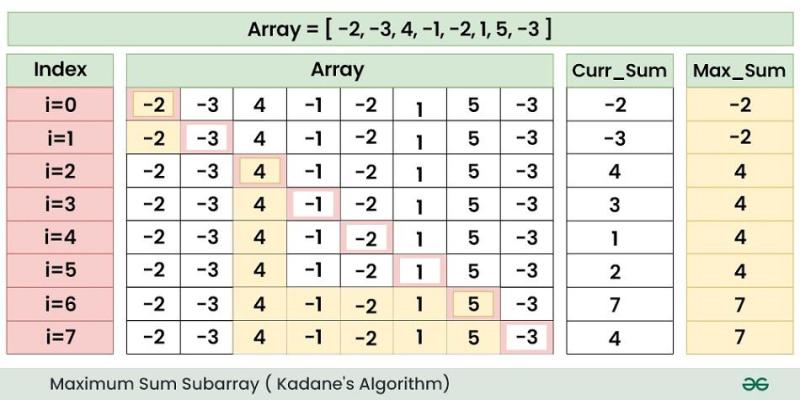
The Complete Overview of Kadane’s Algorithm
Kadane’s algorithm is a dynamic programming technique designed to solve the maximum subarray problem with optimal efficiency. Unlike brute-force methods that evaluate every possible subarray—resulting in O(n²) time complexity—this algorithm processes the array in a single pass, maintaining a running tally of the best possible sum up to each point. Its elegance lies in its minimalism: it doesn’t require additional data structures or complex calculations, yet it guarantees correctness for any sequence of integers, including negative values.The algorithm’s strength is its adaptability. While it was originally formulated for one-dimensional arrays, extensions exist for two-dimensional matrices (e.g., finding the maximum sum rectangle) and even higher dimensions. Its applications span beyond pure computation, influencing fields like machine learning (e.g., feature selection) and operations research (e.g., resource allocation). Yet, its core remains unchanged: a greedy approach that prioritizes local optimality to achieve global results.
Historical Background and Evolution
The problem that Kadane’s algorithm solves dates back to the 1960s, when early computer scientists grappled with efficient ways to analyze sequences of data. The first known solution, attributed to Jay Kadane in a 1984 paper titled "An Efficient Solution to a Geometric Problem," was initially overlooked in favor of more general dynamic programming techniques. However, its linear-time complexity made it a standout, and by the 1990s, it had become a staple in algorithm textbooks, including Introduction to Algorithms by Cormen et al.Kadane’s original work was inspired by a geometric problem involving circular arcs, but the algorithm’s applicability to subarray sums was quickly recognized. The breakthrough wasn’t just in the solution itself but in proving its optimality. Unlike divide-and-conquer methods (e.g., merge sort), which split problems into subproblems, Kadane’s algorithm processes the array sequentially, updating the maximum sum at each step. This approach minimizes overhead and maximizes speed, especially for large datasets where O(n) scalability is critical.
Core Mechanisms: How It Works
At its heart, Kadane’s algorithm operates on two key variables:1. `max_current`: Tracks the maximum subarray sum ending at the current position.
2. `max_global`: Stores the overall maximum subarray sum encountered so far.
Table of Contents
- The Complete Overview of Kadane’s Algorithm
- Historical Background and Evolution
- Core Mechanisms: How It Works
- Key Benefits and Crucial Impact
- Major Advantages
- Comparative Analysis
- Future Trends and Innovations
- Conclusion
- Comprehensive FAQs
- Q: What is the maximum subarray problem, and why is it important?
- Q: Can Kadane’s algorithm handle arrays with all negative numbers?
- Q: How does Kadane’s algorithm compare to brute-force methods?
- Q: Are there variants of Kadane’s algorithm for specific constraints?
- Q: Can Kadane’s algorithm be implemented in languages other than C++ or Python?
- Q: Why is Kadane’s algorithm preferred over divide-and-conquer for this problem?
The algorithm initializes both to the first element of the array. As it iterates through each subsequent element, it decides whether to extend the current subarray or start a new one at the current position. This decision hinges on a simple comparison:
This greedy choice ensures that only the most promising subarrays are retained, eliminating unnecessary computations. The pseudocode is remarkably concise:
```
max_current = max_global = array[0]
for i from 1 to n-1:
max_current = max(array[i], max_current + array[i])
max_global = max(max_global, max_current)
```
The result, `max_global`, is the solution.
Key Benefits and Crucial Impact
Kadane’s algorithm isn’t just fast—it’s transformative. Its linear-time complexity means it can process millions of data points in seconds, a feat that would take hours with quadratic methods. This efficiency is particularly valuable in industries where real-time analysis is critical, such as algorithmic trading or fraud detection. The algorithm’s simplicity also reduces implementation errors, making it a favorite among developers who prioritize maintainability.Beyond performance, the algorithm’s principles have influenced broader algorithmic design. Its use of dynamic programming to avoid redundant calculations has inspired similar optimizations in other domains, from string matching to network routing. Even in non-technical contexts, the idea of "building on the best of what came before" mirrors Kadane’s algorithm’s philosophy: always carry forward the most promising path.
"The beauty of Kadane’s algorithm lies in its ability to turn a problem that seems to require exhaustive search into one that can be solved with a single pass—proof that sometimes, the simplest ideas are the most powerful." — Donald Knuth, The Art of Computer Programming
Major Advantages
- Linear Time Complexity (O(n)): Processes the array in a single traversal, making it ideal for large datasets.
- Minimal Space Usage (O(1)): Requires only a few variables, regardless of input size.
- Handles Negative Numbers: Correctly identifies the maximum subarray even when all elements are negative.
- Adaptable to Variants: Can be extended for problems like maximum subarray with at most k elements.
- Intuitive Implementation: Easy to understand and debug, reducing development time.

Comparative Analysis
While Kadane’s algorithm is the gold standard for the maximum subarray problem, other methods exist with trade-offs in time, space, or flexibility. Below is a comparison of key approaches:| Method | Time Complexity |
|---|---|
| Brute Force | O(n³) (checks all possible subarrays) |
| Divide and Conquer | O(n log n) (recursively splits the array) |
| Dynamic Programming (Kadane’s) | O(n) (optimal for most cases) |
| Sliding Window (Modified Kadane) | O(n) (useful for constrained variants) |
Future Trends and Innovations
As data grows exponentially, the demand for algorithms that can scale without sacrificing accuracy will only increase. Kadane’s algorithm is already being extended to handle more complex scenarios, such as:Emerging fields like quantum computing may also redefine optimization problems, but Kadane’s algorithm’s principles—local optimality leading to global results—will likely remain relevant. Its influence extends beyond coding, serving as a case study in how mathematical elegance can solve practical problems efficiently.

Conclusion
Kadane’s algorithm is more than a solution to a specific problem; it’s a testament to the power of simplicity in algorithmic design. By focusing on the essentials—local decisions leading to global outcomes—it achieves results that would otherwise require brute-force methods. Its applications are vast, from financial modeling to scientific research, and its efficiency makes it indispensable in modern computing.The algorithm’s enduring legacy lies in its ability to inspire. It reminds us that sometimes, the most effective solutions aren’t the most complex, but the ones that distill a problem to its core. As data continues to grow, Kadane’s algorithm will remain a cornerstone of computational efficiency, proving that brilliance often hides in plain sight.
Comprehensive FAQs
Q: What is the maximum subarray problem, and why is it important?
The maximum subarray problem involves finding a contiguous sequence of elements in an array that sums to the largest possible value. It’s important because it models real-world scenarios like identifying profitable stock trends, optimizing resource allocation, or analyzing genetic sequences. Kadane’s algorithm provides an efficient way to solve it in linear time.
Q: Can Kadane’s algorithm handle arrays with all negative numbers?
Yes. The algorithm correctly identifies the least negative (or single largest) element as the maximum subarray when all numbers are negative. This is because it compares each element with the sum of the previous subarray, ensuring the best possible outcome even in adverse conditions.
Q: How does Kadane’s algorithm compare to brute-force methods?
Brute-force methods check every possible subarray, resulting in O(n³) time complexity. Kadane’s algorithm, by contrast, processes the array in O(n) time, making it exponentially faster for large datasets. For an array of size n = 1,000,000, brute force would require ~10¹⁸ operations, while Kadane’s algorithm performs just 1,000,000.
Q: Are there variants of Kadane’s algorithm for specific constraints?
Yes. For example:
Q: Can Kadane’s algorithm be implemented in languages other than C++ or Python?
Absolutely. The algorithm’s pseudocode is language-agnostic and can be implemented in Java, JavaScript, Go, or even functional languages like Haskell. The key is maintaining the two variables (`max_current` and `max_global`) and iterating through the array. Here’s a Python example:
```python
def kadane(arr):
max_current = max_global = arr[0]
for num in arr[1:]:
max_current = max(num, max_current + num)
max_global = max(max_global, max_current)
return max_global
```
Q: Why is Kadane’s algorithm preferred over divide-and-conquer for this problem?
Divide-and-conquer methods (e.g., splitting the array into halves) introduce O(n log n) overhead due to recursion and merging steps. Kadane’s algorithm avoids this by processing the array in a single pass, making it faster and more memory-efficient. The trade-off is that divide-and-conquer can be more intuitive for some developers, but Kadane’s linear approach is superior for performance-critical applications.
Leave a Comment
Comments are moderated before appearing. The data you submit is processed according to the Privacy Policy of Gouv.