The Definitive Address Book Creation Guide: Crafting Precision in Every Entry
The address book—once a leather-bound relic of stationery elegance—has evolved into a dynamic, multifunctional tool essential for both personal and professional spheres. Its transformation mirrors broader shifts in how we manage relationships, prioritize accessibility, and integrate technology into daily workflows. Yet, despite digital dominance, the principles of meticulous address book creation remain timeless: clarity, categorization, and consistency. Whether you're curating a sleek digital roster or a handwritten ledger, the fundamentals of organization dictate success.
Modern address books transcend mere contact storage; they serve as strategic assets. A well-constructed address book isn’t just a repository—it’s a curated network, a reflection of professionalism, and a gateway to efficiency. The nuances of its creation—from field selection to data security—demand deliberate attention. This guide dissects the anatomy of address book creation, blending historical context with contemporary best practices to ensure your system aligns with precision and purpose.
Consider the paradox: while digital tools promise instant accessibility, the most effective address books—whether analog or digital—rely on a human touch. The art lies in balancing automation with intentionality. A poorly structured address book becomes a liability; a thoughtfully designed one becomes an extension of your operational intelligence. This is the core of the address book creation comprehensive guide: a framework to elevate your contact management from functional to exceptional.

The Complete Overview of Address Book Creation
The foundation of any address book lies in its purpose. A personal address book prioritizes family, friends, and local services, while a professional version demands fields for job titles, company affiliations, and communication preferences. The distinction isn’t just semantic—it dictates structure. For instance, a freelancer’s address book might include project-specific notes, whereas a corporate executive’s requires hierarchical clarity and CRM integration.
At its core, address book creation is a discipline of systematic organization. It begins with defining entry types—individuals, organizations, or hybrid contacts—and progresses to field customization. Digital platforms like Apple Contacts or HubSpot offer templates, but the most effective systems are tailored. A lawyer’s address book might include case references; a salesperson’s could track follow-up dates. The key is adaptability: a static template fails; a dynamic one thrives.
Historical Background and Evolution
The address book’s origins trace back to the 19th century, when stationery manufacturers capitalized on the growing need for personal record-keeping. Early versions were manual, often bound in leather or cloth, with entries meticulously penned in ink. The rise of the telephone in the early 20th century accelerated demand, leading to the inclusion of phone numbers—a field that would later expand to emails, mobile numbers, and social media handles.
Table of Contents
- The Complete Overview of Address Book Creation
- Historical Background and Evolution
- Core Mechanisms: How It Works
- Key Benefits and Crucial Impact
- Major Advantages
- Comparative Analysis
- Future Trends and Innovations
- Conclusion
- Comprehensive FAQs
- Q: What’s the best field structure for a professional address book?
- Q: How often should I update my address book?
- Q: Can I merge analog and digital address books?
- Q: What security measures should I implement for my digital address book?
- Q: How do I handle international contacts in my address book?
- Q: What’s the most efficient way to organize contacts by category?
- Q: Are there address book tools tailored for specific industries?
Digital disruption arrived in the 1990s with the advent of personal computers and early contact management software. Tools like Microsoft Outlook and Palm OS pioneered digital address books, offering searchability and synchronization. By the 2010s, cloud-based solutions and mobile apps redefined accessibility, enabling real-time updates across devices. Yet, despite these advancements, the core principles of address book creation—logical grouping, consistent labeling, and prioritization—remain unchanged. The evolution has been about efficiency, not reinvention.
Core Mechanisms: How It Works
Every address book operates on two pillars: data input and retrieval. Input involves capturing contact details—names, addresses, and supplementary notes—while retrieval ensures these details are accessible when needed. The mechanism differs by medium: analog books rely on manual indexing (e.g., alphabetical or categorical tabs), while digital systems use metadata tags, search algorithms, and API integrations.
Consider the workflow of a digital address book creation process. First, you define fields (e.g., "Work Email," "Preferred Contact Method"). Next, you populate entries, often via bulk import or manual entry. Finally, you implement filters or labels (e.g., "VIP," "Past Client") to streamline searches. The magic lies in the backend: a well-structured database allows for cross-referencing, duplicate detection, and even predictive suggestions. Analog methods achieve similar goals through physical organization—dividers, color-coding, and sticky notes—but lack scalability.
Key Benefits and Crucial Impact
An address book isn’t just a tool; it’s a multiplier of productivity. For professionals, it reduces the time spent hunting for contact details from minutes to seconds. For personal use, it ensures no birthday or anniversary slips through the cracks. The impact extends to relationship management: a well-maintained address book signals professionalism and attention to detail, whether you’re networking at a conference or reconnecting with an old client.
The psychological benefit is often overlooked. A structured address book reduces cognitive load by offloading memory tasks. Studies on decision fatigue suggest that mental clutter diminishes efficiency; an organized contact system mitigates this. Moreover, in an era of data breaches, a secure address book—whether encrypted or password-protected—safeguards sensitive information, adding a layer of digital hygiene.
"An address book is the unsung hero of professional relationships. It’s where intent meets execution—where a name isn’t just a label, but a bridge to opportunity."
— Sarah Chen, Networking Strategist and Author of Connections That Count
Major Advantages
- Time Efficiency: Eliminates the need to recall or re-enter contact details, saving hours annually. Digital tools with autocomplete further accelerate this.
- Professional Polishing: A polished address book reflects discipline, whether shared with colleagues or referenced in meetings. Gaps or outdated entries erode credibility.
- Network Expansion: Categorized contacts (e.g., "Industry Peers," "Potential Partners") facilitate targeted outreach, turning passive contacts into active opportunities.
- Data Security: Encrypted digital address books or physically secured analog ledgers protect against unauthorized access, a critical factor in compliance-heavy industries.
- Cross-Platform Synergy: Modern address books sync across devices via cloud services, ensuring consistency whether you’re on a desktop, smartphone, or tablet.
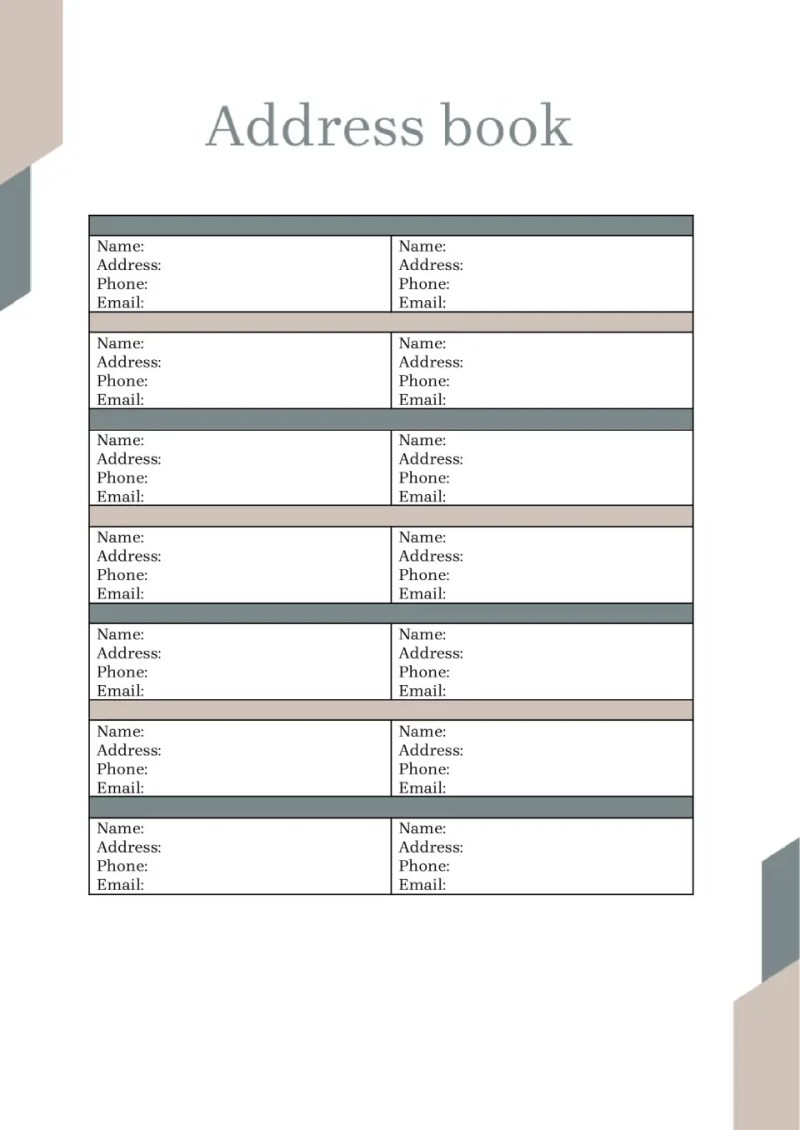
Comparative Analysis
| Feature | Analog Address Book | Digital Address Book |
|---|---|---|
| Accessibility | Physical presence required; no remote access. | Cloud-based or device-linked; accessible anywhere with internet. |
| Customization | Limited to manual additions (e.g., sticky notes, separate sections). | Highly customizable fields, labels, and integrations (e.g., CRM tools). |
| Backup and Recovery | Prone to loss/damage; no automatic backups. | Automated backups and version history; disaster recovery options. |
| Collaboration | Shared via photocopies or manual updates; error-prone. | Real-time sharing via tools like Google Contacts or Notion; version control. |
Future Trends and Innovations
The next frontier of address book creation lies in artificial intelligence and predictive analytics. Imagine an address book that not only stores contacts but also suggests optimal times to reach them based on past interactions. AI-driven tools could analyze communication patterns—email responses, meeting attendance—to prioritize follow-ups. For instance, a salesperson’s address book might flag a prospect who typically replies to emails sent on Tuesdays.
Blockchain technology could revolutionize security, offering decentralized, tamper-proof contact databases. Meanwhile, voice-activated assistants (e.g., Siri, Alexa) are blurring the lines between address books and smart calendars, enabling hands-free contact management. The future isn’t about replacing address books but enhancing their intelligence—turning them from static directories into dynamic relationship engines.

Conclusion
The address book creation comprehensive guide underscores a timeless truth: organization is the backbone of effectiveness. Whether you’re a solopreneur, a corporate executive, or simply someone who values order, the principles remain constant—clarity, accessibility, and adaptability. The tools may evolve, but the core remains: a well-crafted address book is more than a list; it’s a strategic asset.
As you refine your approach, consider this: the best address books are those that grow with you. Start with a template, iterate based on usage, and embrace technology without sacrificing the human element. In an age of information overload, a meticulously curated address book is your compass—navigating relationships with precision and purpose.
Comprehensive FAQs
Q: What’s the best field structure for a professional address book?
A: For professionals, prioritize fields like "Full Name," "Job Title," "Company," "Work Email," "Mobile/Phone," "Preferred Contact Method," and "Notes" (for context like meeting history). Add custom fields based on industry needs (e.g., "Project Role" for freelancers or "Client Tier" for sales teams). Digital tools like HubSpot or Capsule allow unlimited customization.
Q: How often should I update my address book?
A: Aim for quarterly reviews to remove duplicates, verify outdated contacts, and add new entries. Set calendar reminders or use digital tools with expiration alerts (e.g., Google Contacts flags contacts not used in 6+ months). For high-stakes roles (e.g., legal, finance), monthly checks are advisable.
Q: Can I merge analog and digital address books?
A: Yes. Start by digitizing your analog book using OCR tools (e.g., Adobe Scan) or manual entry into a digital platform like Notion or Evernote. Cross-reference entries to avoid duplicates. For ongoing sync, use a hybrid approach: maintain a physical backup for sentimental or sensitive contacts while relying on digital for daily use.
Q: What security measures should I implement for my digital address book?
A: Use end-to-end encryption (e.g., ProtonMail for contacts), enable two-factor authentication, and store backups in secure cloud services (e.g., Dropbox with password protection). For sensitive data, consider dedicated tools like Keeper or 1Password, which integrate with address book apps. Regularly audit permissions to limit access.
Q: How do I handle international contacts in my address book?
A: Include fields for country codes (e.g., "+44" for UK), time zones (to avoid scheduling conflicts), and preferred languages. For business contacts, note cultural communication norms (e.g., formal vs. informal email tones). Tools like World Time Buddy integrate with calendars to simplify coordination across time zones.
Q: What’s the most efficient way to organize contacts by category?
A: Use a tiered system: primary categories (e.g., "Family," "Work," "Clients") with subcategories (e.g., under "Work," add "Team," "Vendors," "Mentors"). Digital tools allow color-coding or tags (e.g., #urgent, #follow-up). For analog books, use dividers with clear labels or sticky notes for quick visual reference.
Q: Are there address book tools tailored for specific industries?
A: Absolutely. Real estate professionals use tools like Follow Up Boss to track client interactions, while healthcare providers rely on Athenahealth for HIPAA-compliant contact management. Legal firms often integrate address books with case management software (e.g., Clio). Always choose tools with industry-specific compliance features.
Leave a Comment
Comments are moderated before appearing. The data you submit is processed according to the Privacy Policy of Gouv.