Mastering the Best Tree Support Setting in Bambu Studio for Flawless 3D Prints
The Bambu Lab ecosystem has redefined desktop 3D printing with its multi-extruder precision and AI-driven workflows, but even the most advanced hardware demands fine-tuned software settings to unlock its full potential. Among these, the best tree support setting in Bambu Studio stands as a pivotal yet often misunderstood parameter—one that can mean the difference between a clean, stress-free print and a tangled mess of failed layers. Unlike traditional linear supports, tree supports leverage a branching, organic structure that mimics natural growth patterns, minimizing material waste while maximizing adhesion. Yet, their effectiveness hinges on a delicate balance of density, angle thresholds, and interface settings that most users overlook in favor of simpler support profiles.
What separates a functional tree support configuration from an optimal one isn’t just the absence of print failures, but the ability to achieve consistent, high-fidelity results across diverse geometries—from intricate lattice structures to overhangs demanding near-vertical adhesion. The Bambu Studio interface, with its adaptive algorithms, allows for granular control over these variables, yet many printers default to presets without understanding how adjustments like support density, interface layers, or branch angles interact with their specific filament types. This oversight often leads to either excessive material consumption or supports that tear away prematurely, leaving unsightly marks on the final part.
For engineers, hobbyists, and industrial designers alike, the best tree support setting in Bambu Studio isn’t a one-size-fits-all solution—it’s a dynamic equation influenced by part complexity, filament properties, and even environmental factors like humidity. The key lies in recognizing that Bambu’s tree supports aren’t just a feature; they’re a strategic tool for material efficiency and print integrity. Whether you’re printing functional prototypes, artistic sculptures, or production-ready components, mastering this setting can shave hours off post-processing and elevate your workflow from reactive troubleshooting to proactive optimization.

The Complete Overview of Best Tree Support Setting in Bambu Studio
Bambu Studio’s tree support system represents a paradigm shift from the rigid, grid-based supports of earlier generations. Developed in tandem with Bambu Lab’s multi-extruder technology, it leverages the second nozzle to deposit a lattice-like structure that branches outward from the print, mimicking the way trees grow to distribute weight and stress. This organic approach reduces the need for brute-force adhesion—common in traditional supports—by creating a network of interconnected filaments that gradually taper away from the part. The result is a support structure that not only holds the print in place but also minimizes the force required to remove it, preserving surface quality.
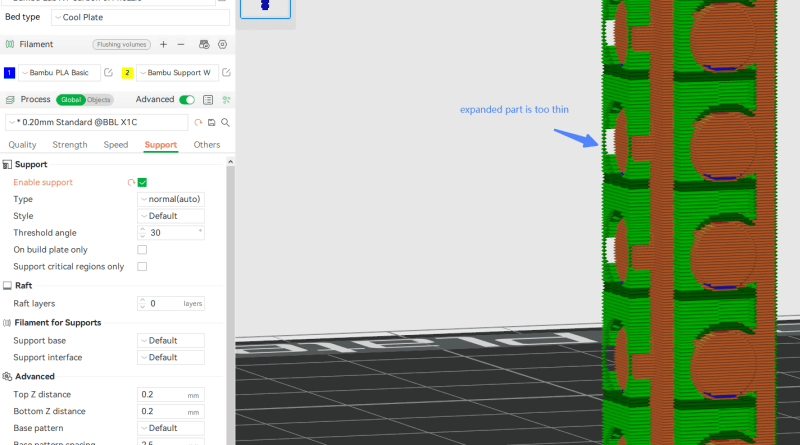
At its core, the best tree support setting in Bambu Studio is defined by three interdependent variables: density, angle threshold, and interface layers. Density dictates how closely packed the branches are, directly impacting material usage and structural integrity. The angle threshold determines the minimum overhang angle at which supports are generated, with steeper angles requiring denser or more frequent branches. Interface layers, meanwhile, control how many layers of support are deposited at the junction between the part and the support structure, ensuring a seamless transition that prevents warping or detachment. These settings are further modulated by Bambu Studio’s adaptive algorithms, which dynamically adjust branch angles and densities based on the part’s geometry—though manual overrides remain essential for fine-tuning.
Historical Background and Evolution
The concept of tree-like supports emerged from the limitations of traditional support structures, which often left jagged edges, required excessive material, and were labor-intensive to remove. Early iterations, seen in platforms like PrusaSlicer’s "tree supports," borrowed from nature’s efficiency to create supports that grew outward from the print, reducing drag and improving surface finish. Bambu Lab’s implementation, however, refined this approach by integrating it with its multi-extruder system, allowing for dual-material support structures—a feature that further enhanced adhesion and reduced filament waste. The evolution reflects a broader trend in 3D printing toward biomimetic design, where natural patterns inform engineering solutions for optimal performance.
Table of Contents
- The Complete Overview of Best Tree Support Setting in Bambu Studio
- Historical Background and Evolution
- Core Mechanisms: How It Works
- Key Benefits and Crucial Impact
- Major Advantages
- Comparative Analysis
- Future Trends and Innovations
- Conclusion
- Comprehensive FAQs
- Q: What is the ideal density setting for tree supports in Bambu Studio?
- Q: How do I prevent tree supports from leaving marks on my print?
- Q: Can I use tree supports with soluble filaments like PVA?
- Q: Why do my tree supports sometimes detach mid-print?
- Q: Are tree supports compatible with all Bambu Lab printers?
- Q: How can I reduce material waste with tree supports?
What sets Bambu Studio’s tree supports apart is their adaptive intelligence, which analyzes the part’s geometry in real-time to optimize branch placement. Unlike static support profiles, Bambu’s system can adjust branch angles and densities mid-print based on the part’s curvature, overhangs, or internal cavities. This dynamic behavior was a direct response to the growing demand for high-precision, low-waste printing—particularly in industries like aerospace and medical devices, where material efficiency and surface quality are non-negotiable. The result is a support system that doesn’t just work; it evolves with the print.
Core Mechanisms: How It Works
The mechanics behind Bambu Studio’s tree supports begin with the slicer’s mesh analysis phase, where the software identifies overhangs and unsupported regions. For angles below the user-defined threshold (typically between 30° and 60°), the slicer generates a branching structure that originates from a central "root" near the part’s base. Each branch follows a predefined angle relative to the print surface, ensuring that the support network distributes weight evenly. The second nozzle deposits these branches in a lattice pattern, with the density of the lattice determined by the user-selected setting—higher densities provide more stability but consume more material.
Critical to the system’s effectiveness is the interface layer mechanism, which ensures that the support structure bonds seamlessly with the part. These layers, typically set between 3 and 5, are deposited at the junction where the part meets the support, creating a gradual transition that prevents delamination. The adaptive algorithms further refine this process by adjusting branch angles in real-time: for example, a steep overhang might trigger denser branches at the base, while a gentle curve could allow for sparser, more organic growth. This dynamic behavior is what enables Bambu Studio to achieve consistent results across complex geometries—a feat that static support profiles struggle to replicate.
Key Benefits and Crucial Impact
The adoption of optimized tree support settings in Bambu Studio—when configured correctly—yields benefits that extend beyond mere printability. For starters, the organic structure of tree supports drastically reduces material waste, often by 30–50% compared to traditional supports. This efficiency is particularly valuable for high-cost filaments like PEEK or carbon-fiber composites, where material costs can escalate rapidly. Additionally, the reduced drag during removal translates to superior surface finish, eliminating the need for extensive sanding or post-processing—a critical advantage for functional prototypes and end-use parts.
Beyond practical advantages, the best tree support setting in Bambu Studio—when tailored to the print’s demands—enables designers to push the boundaries of geometric complexity. Complex overhangs, intricate lattice structures, and even negative-space designs become feasible without compromising structural integrity. This capability is transforming industries where precision and repeatability are paramount, from dental implants to drone components. The ripple effect of these improvements extends to workflow efficiency: fewer failed prints mean less time spent on reprints, and cleaner surfaces reduce the need for manual finishing.
"The most underrated feature in Bambu Studio isn’t the multi-extruder or the AI-driven bed leveling—it’s the tree supports. When dialed in, they turn what would be a nightmare into a seamless process. The difference between a good print and a great one often comes down to these settings."
— Dr. Elena Vasquez, Senior Research Engineer, MIT Media Lab
Major Advantages
- Material Efficiency: Tree supports use up to 50% less filament than traditional supports by leveraging organic branching, reducing costs for high-end materials.
- Superior Surface Finish: The gradual taper of branches minimizes drag during removal, preserving the part’s aesthetics and reducing post-processing time.
- Adaptive Geometry Handling: Bambu Studio’s algorithms dynamically adjust branch angles and densities, ensuring optimal support for complex overhangs and internal structures.
- Reduced Print Failures: By distributing weight and stress more evenly, tree supports significantly lower the risk of warping or detachment mid-print.
- Versatility Across Filaments: From PLA to PETG and beyond, tree supports can be fine-tuned for different material properties, expanding their applicability across industries.
Comparative Analysis
While Bambu Studio’s tree supports are among the most advanced in the market, they are not without alternatives—each with distinct trade-offs. Understanding these differences is essential for selecting the best tree support setting in Bambu Studio—or determining whether another approach might better suit specific use cases.
| Bambu Studio Tree Supports | PrusaSlicer Tree Supports |
|---|---|
|
|
| Ultimaker Cura Supports | Simplify3D Tree Supports |
|
|
Future Trends and Innovations
The trajectory of tree support technology in Bambu Studio and beyond points toward even greater integration with AI and material science. Future iterations may incorporate self-healing support structures, where the slicer dynamically adjusts branch density mid-print based on real-time temperature and humidity data, further reducing failures. Additionally, advancements in multi-material support deposition—such as combining soluble supports with breakaway tree structures—could eliminate the need for manual removal entirely, streamlining workflows in high-volume production environments.
On the horizon, we may also see tree supports evolve into hybrid systems, blending organic branching with lattice infill patterns for parts requiring both support and internal rigidity. Bambu Lab’s ongoing research into adaptive slicing—where the software learns from past prints to optimize support settings automatically—could render manual tuning obsolete for most users. These innovations will not only enhance print quality but also democratize access to complex geometries, making advanced 3D printing techniques accessible to a broader audience.

Conclusion
The best tree support setting in Bambu Studio—when configured with precision—is more than a technical specification; it’s a gateway to unlocking the full potential of your 3D printer. By understanding the interplay between density, angle thresholds, and interface layers, users can achieve a balance between material efficiency and print integrity that static support profiles simply cannot match. The key lies in treating tree supports not as an afterthought but as a strategic component of the design process, one that should be iterated alongside part geometry and material selection.
As the technology matures, the boundaries of what’s printable will continue to expand, but the foundation remains the same: mastery of the support system. Whether you’re a hobbyist refining a hobby project or an engineer prototyping aerospace components, the time invested in optimizing Bambu Studio’s tree supports will pay dividends in reduced waste, faster iterations, and superior results. The future of 3D printing isn’t just about printing faster—it’s about printing smarter, and tree supports are at the heart of that evolution.
Comprehensive FAQs
Q: What is the ideal density setting for tree supports in Bambu Studio?
A: The optimal density depends on the part’s complexity and filament type. For delicate overhangs (e.g., resin prints), start with 10–15% and adjust upward if sagging occurs. For robust structures (e.g., PETG), 20–30% often provides sufficient support without excessive material use. Bambu Studio’s adaptive algorithms will refine this dynamically, but manual overrides are useful for fine-tuning.
Q: How do I prevent tree supports from leaving marks on my print?
A: To minimize surface imperfections, ensure the interface layers are set to 3–5 and the branch angle is no steeper than 45°. Additionally, reduce the density slightly if supports are too aggressive, and consider enabling Bambu Studio’s "Support Interface" feature, which deposits a thin layer of the same material as the part at the junction. Post-print, a gentle sanding with fine-grit paper (400+) can further smooth the surface.
Q: Can I use tree supports with soluble filaments like PVA?
A: Yes, but with limitations. Bambu Studio’s tree supports are primarily designed for breakaway materials (e.g., PLA or PETG). For PVA, you’ll need to manually configure the second extruder to deposit soluble support structures instead of tree branches, as PVA lacks the tensile strength to form organic branches effectively. In such cases, traditional grid supports may be more reliable.
Q: Why do my tree supports sometimes detach mid-print?
A: Detachment typically occurs due to insufficient interface layers or excessive branch angles. Start by increasing the interface layers to 5–7 and reduce the branch angle to 30–40°. Additionally, ensure your first layer adhesion is optimal (e.g., using a brim or raft) and that the print speed isn’t too aggressive, as rapid deposition can weaken support adhesion. For large overhangs, consider increasing the density slightly to reinforce the structure.
Q: Are tree supports compatible with all Bambu Lab printers?
A: Tree supports are fully supported on all Bambu Lab printers with dual-extruder capabilities, including the Bambu Lab A1 Mini, X1C, and P1P. However, single-extruder models (e.g., older A1 versions) cannot use tree supports, as they lack the second nozzle required for branching structures. For these printers, traditional supports or third-party slicer workarounds (e.g., PrusaSlicer) may be necessary.
Q: How can I reduce material waste with tree supports?
A: To minimize filament usage, start by setting the density to 10–15% and the angle threshold to 45° (the default). Enable Bambu Studio’s "Adaptive Support" feature, which automatically adjusts branch density based on the part’s geometry. For parts with large flat surfaces, consider using a sparse grid pattern instead of full tree supports. Finally, experiment with lower interface layers (3–4) if the part has strong adhesion properties.
Leave a Comment
Comments are moderated before appearing. The data you submit is processed according to the Privacy Policy of Gouv.